Spirit of Contradiction
At each presentation of her recent pictorial creations, Seble surprises us with the constant evolution of her style; an evolution that reflects her incessant contemplation of art, of the world, of life.
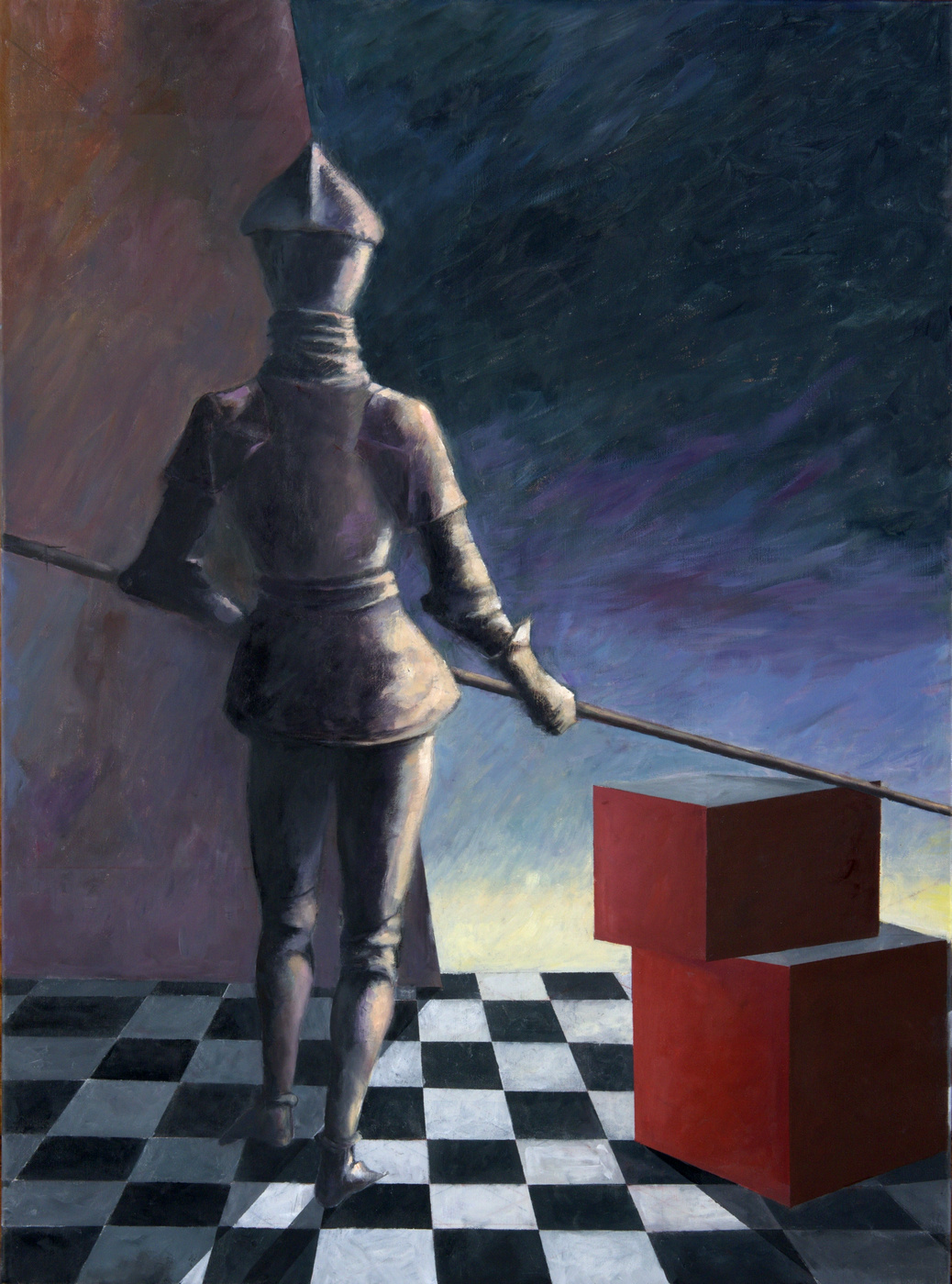
Self-Portrait
Compared to the warm shades of her previous work – that almost recalls the desert surroundings of her land of origin, Eritrea and Ethiopia – which was dominated by dramatic shades of yellow and red, Seble now places us before a prevalence of brush strokes that range from bright blue to light blue, from dark gray to white, giving her work a much colder feeling.
Her universes are not hospitable and, while the artist used to offer comfort and hopeful ways of escape, we are now confronted with worlds that are desolate, menacing and, at the same time, of great poetic suggestion.
The chromatic transformations blend in with a blank pictorial space: architecture that is of minimalist rationalism, without any internal signs of life, stands against plumbean skies.
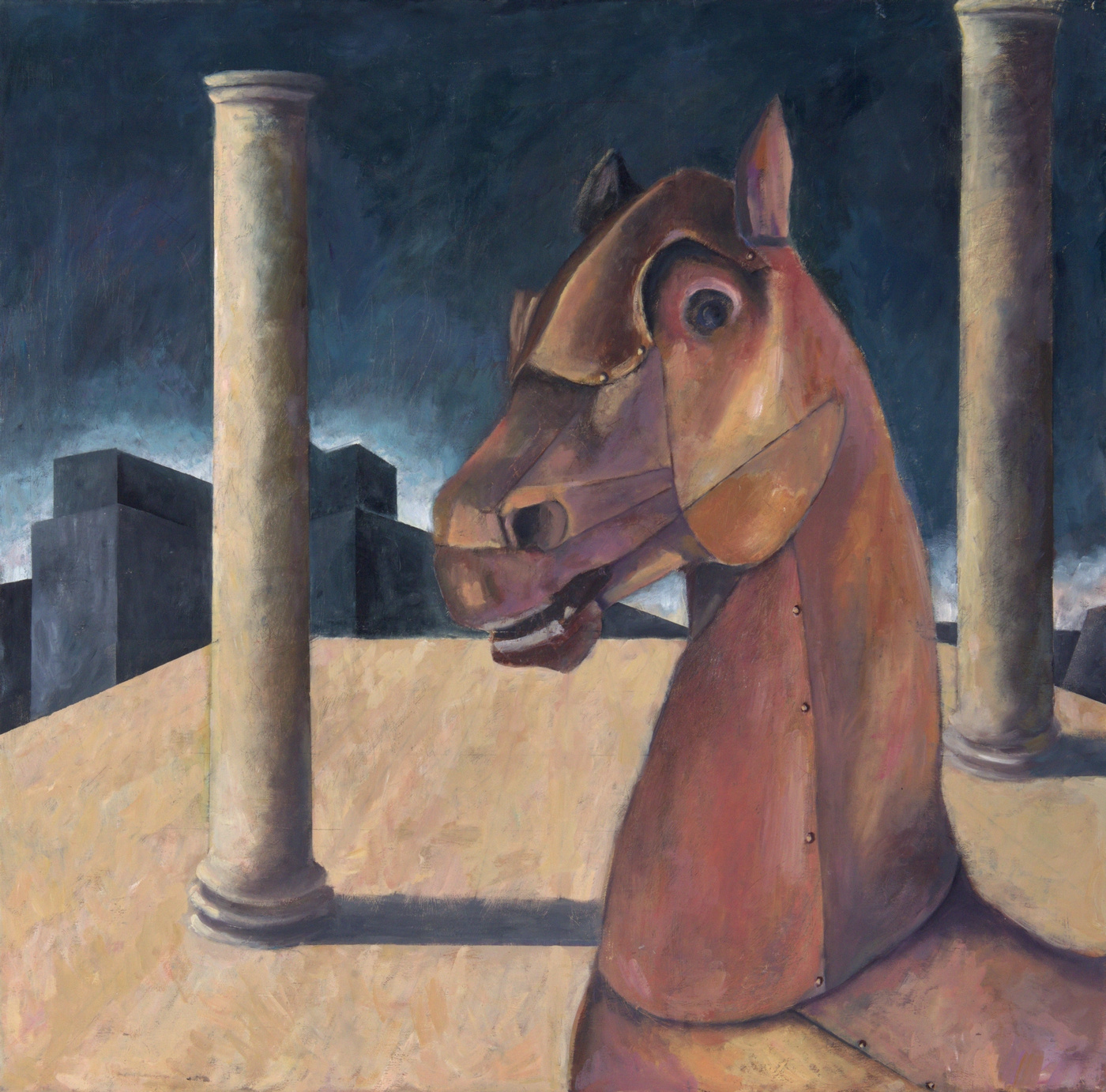
The Power of the Subconscious
The metaphysical universes that Seble has created for years are accentuated, and appear in the most synthetized forms among deserted buildings and columns scattered in ever-more audacious perspectives that lack any points of reference, completely suspended, as in the work entitled
The power of the Subconscious
: a horse’s head, disassembled according to quasi-cubist principles, is placed on an inclined plane and almost seems to fall on it, while it stares at the spectator from above with an unsettling look.
Since ancient times, the horse has been a symbol of strength and power and it was transformed in the twentieth century, with futurism and The Blue Knight, in an experimental figure that – with Picasso’s Guernica – then became a symbol of the suffering of an entire population. Seble’s horse appears to want to become part of this iconography, with reference to the increasing problems of today’s world.
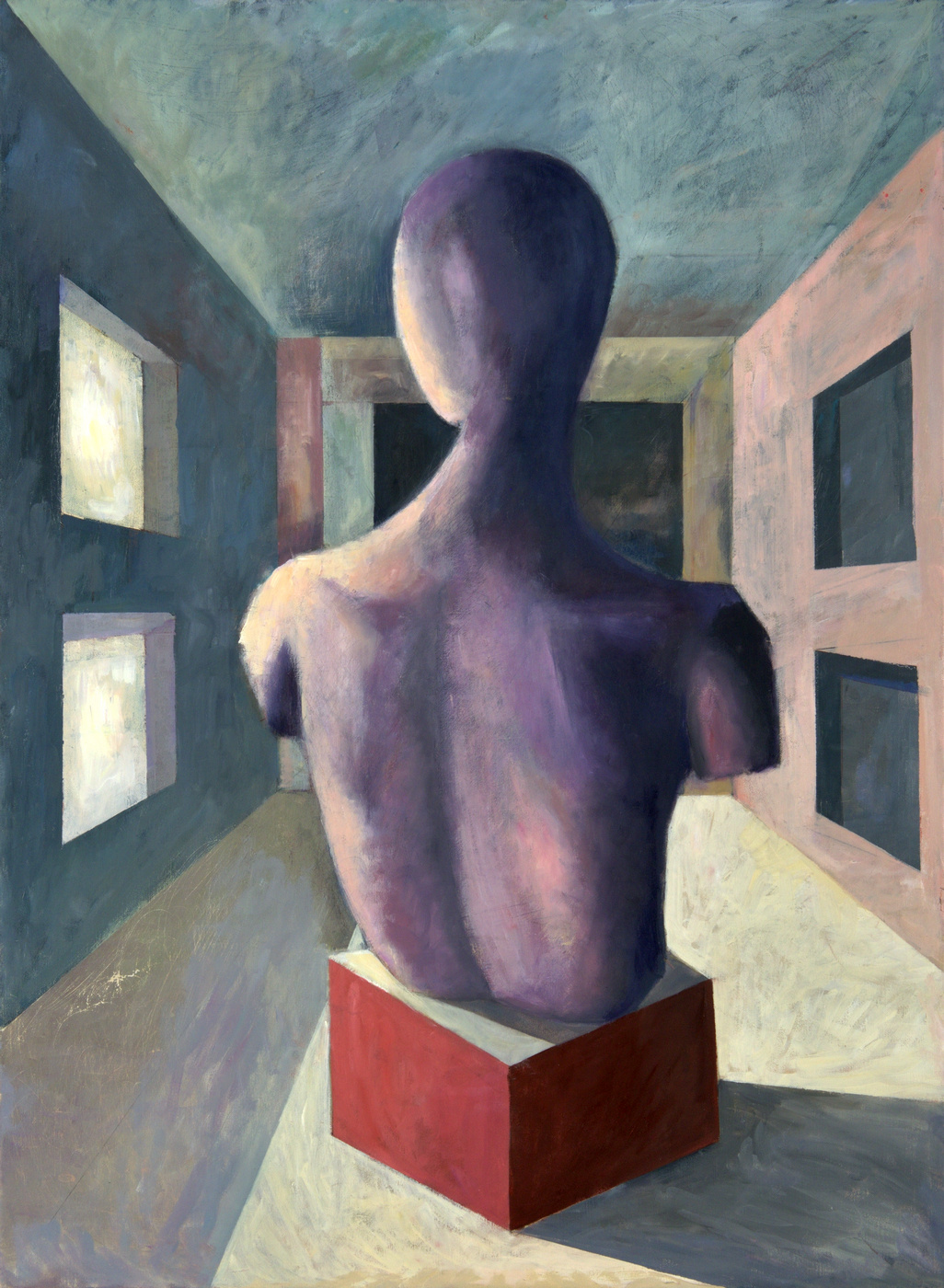
Unexpected Guest
Signs of a threatened civilization are also expressed in the revisiting of ancient statues. Clearly a reference to her new homeland, Italy, the mutilated busts without any arms or face replace the African masks and statues that populated the artist’s previous work, becoming metaphors of the individual’s solitude in large cities.
Numerous of the subjects in the new paintings are a testimony to the fact that Seble has abandoned her original imaginary to elaborate, in a completely individual way, the influence of the artistic and cultural environment that has surrounded her for many years.
The solutions are always of great visual impact and totally unprecedented. As in classic Renaissance portraits, in which glimpses of landscapes and cities that are visible through windows indicate the geographical context of the character depicted in the foreground, Seble also evokes sceneries, but certainly ones that are no longer picturesque. The twin towers that are perceived in the background, in an extremely formal synthesis of New York, in fact purely play the role of a Recovering memory , as explained by the title of the work.
Seble's Self-portrait brings global concerns to an individual dimension. The slender build of the figure contrasts with the heavy armor that, ironically, in its obscurity, highlights the subconscious of the artist; an absolutely defensive approach to the world, reinforced by the fact that it does not openly reveal its identity. The figure is placed with its back turned, which is fairly rare in the iconography of self-portraits, while it is clearly attributable to Romanticism and, in particular, to Caspar David Friedrich and his famous Wanderer above the sea of fog, a solitary figure placed in front of a heightened and inhospitable landscape. The observer has the same perspective as the depicted figure. The artist thus engages us in her view of the world, through a few elements that are elegantly inserted in her work and related to her story: the boxes recall her baggage, cultural and material, upon her arrival in Italy as an immigrant; the checkered floor in the forefront recalls the childhood home that she left behind.
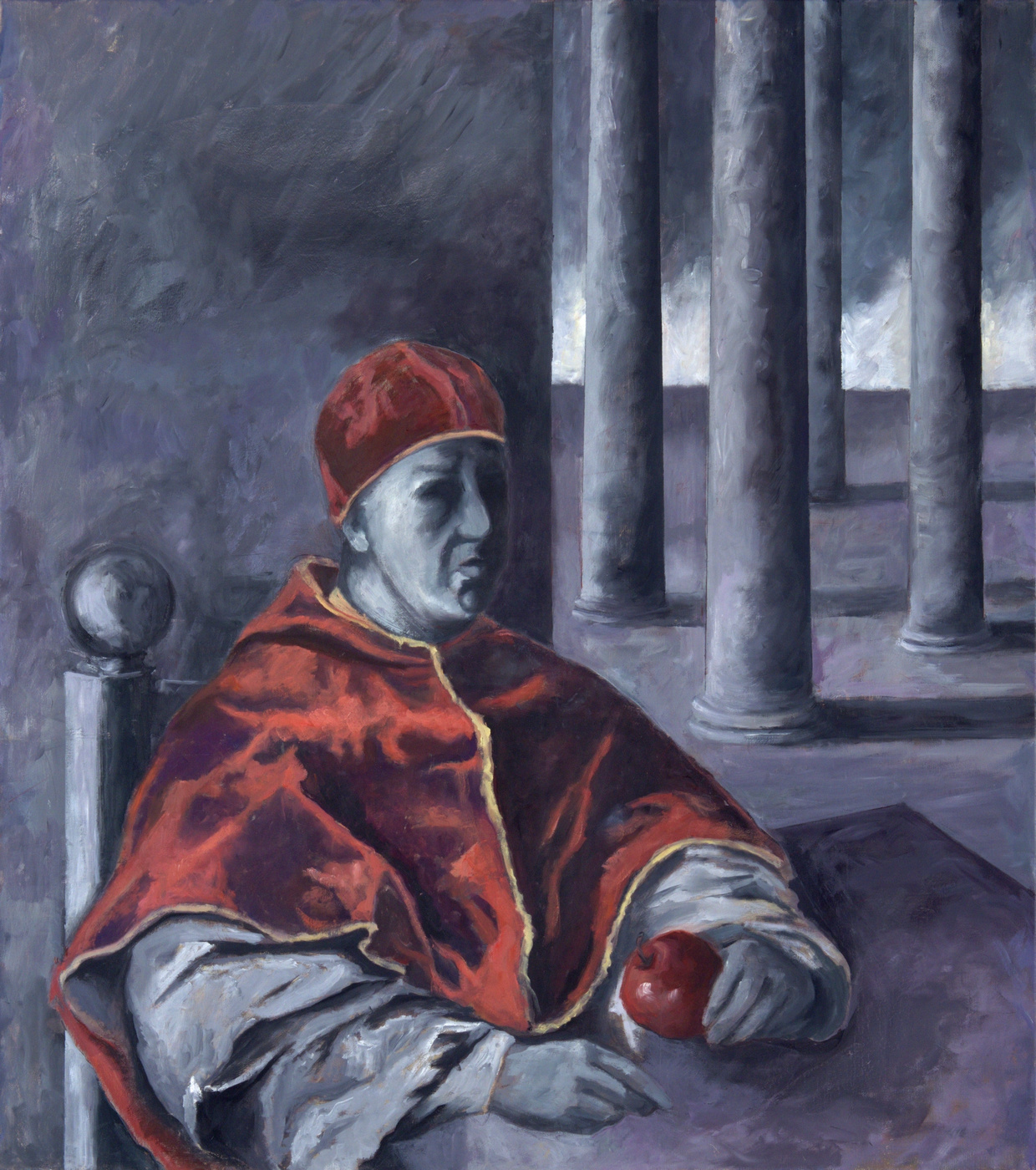
The Dress
The historical-artistic references to some of the characters depicted in other portraits are even more explicit. In The dress we recognize the famous, and at the time innovative, Portrait of Pope Leo X with Two Cardinals, Giulio de’ Medici and Luigi de’ Rossi, stored at the Uffizi. But here the Pope is alone and immersed in a desolating atmosphere accentuated by gray tones, from which emerge only the red of the camauro and of the mozzetta cape that he is wearing. The lens, which – in the original portrait – the Pope holds in his hand as he reads a precious manuscript, here is replaced by a red apple, which at first glance seems to be an object out of place but instead acquires a definite meaning: it hints to the fact that the Pope, a cultured humanist and great patron of arts, never relinquished the splendor of his court despite the beginning of religious conflicts for the Lutheran reform.
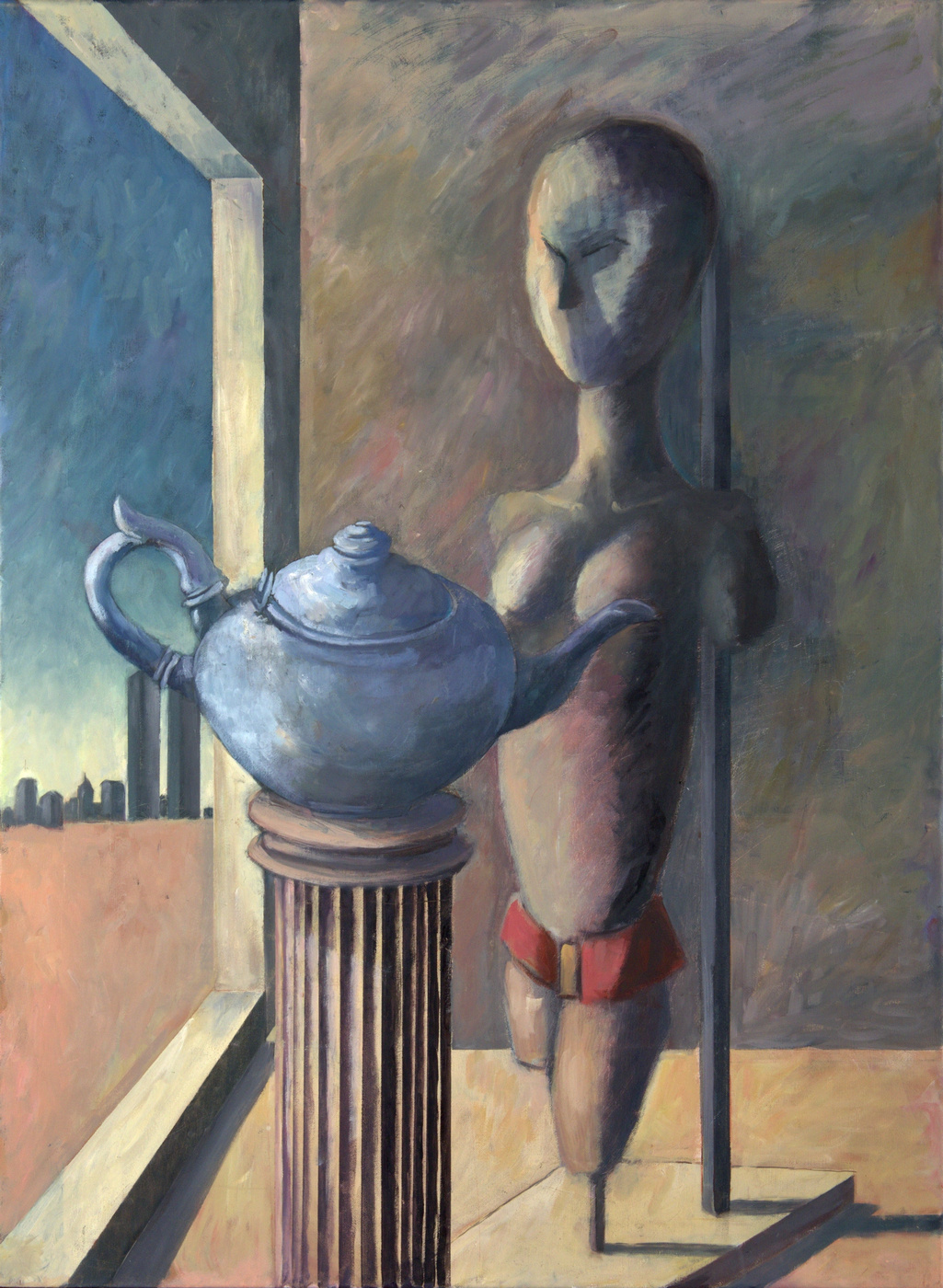
UntitledOften it is precisely the everyday objects, introduced in the work in a seemingly incongruous manner, that express one of the key concepts of Seble’s art: the spirit of contradiction. In the work entitled The Intruder, a Christmas star is positioned exactly in front of the portrait of a young clerical, covering half of his face. A teapot takes the place of the protagonist, “portrayed” in front of a window with a view that vaguely recalls New York, that stands on a classic column. Its interlocutor is a mutilated mannequin. The classic structure, almost Renaissance-like, of the portrait is denied with a pronounced sense of irony, taking on Magritte-like dimensions and therefore clearly a surrealist style. By doing so, Seble plays with genres and historical-artistic ages, creating an individual aesthetic that is, at the same time, wise and playful.
Self-Portrait
Her universes are not hospitable and, while the artist used to offer comfort and hopeful ways of escape, we are now confronted with worlds that are desolate, menacing and, at the same time, of great poetic suggestion.
The chromatic transformations blend in with a blank pictorial space: architecture that is of minimalist rationalism, without any internal signs of life, stands against plumbean skies.
The Power of the Subconscious
Unexpected Guest
Numerous of the subjects in the new paintings are a testimony to the fact that Seble has abandoned her original imaginary to elaborate, in a completely individual way, the influence of the artistic and cultural environment that has surrounded her for many years.
The solutions are always of great visual impact and totally unprecedented. As in classic Renaissance portraits, in which glimpses of landscapes and cities that are visible through windows indicate the geographical context of the character depicted in the foreground, Seble also evokes sceneries, but certainly ones that are no longer picturesque. The twin towers that are perceived in the background, in an extremely formal synthesis of New York, in fact purely play the role of a Recovering memory , as explained by the title of the work.
Seble's Self-portrait brings global concerns to an individual dimension. The slender build of the figure contrasts with the heavy armor that, ironically, in its obscurity, highlights the subconscious of the artist; an absolutely defensive approach to the world, reinforced by the fact that it does not openly reveal its identity. The figure is placed with its back turned, which is fairly rare in the iconography of self-portraits, while it is clearly attributable to Romanticism and, in particular, to Caspar David Friedrich and his famous Wanderer above the sea of fog, a solitary figure placed in front of a heightened and inhospitable landscape. The observer has the same perspective as the depicted figure. The artist thus engages us in her view of the world, through a few elements that are elegantly inserted in her work and related to her story: the boxes recall her baggage, cultural and material, upon her arrival in Italy as an immigrant; the checkered floor in the forefront recalls the childhood home that she left behind.
The Dress
Untitled
Tanja Legelmann